

A lot happened this August. ChatGPT started rolling out ads in India.
Reddit suddenly lost a huge share of its citations in ChatGPT Search.
LinkedIn introduced a way for users to flag AI-generated content.
Google released another spam update. YouTube changed how it counts views.
Google made Ads and Analytics more AI-powered.
Claude introduced invisible markers for AI-generated text and LinkedIn openly shared how brands can build credibility for AI search.
At first, these look like completely different updates. They aren’t. They all point towards one bigger shift:
Online visibility is becoming less about simply being present and more about being selected.
Selected by search engines, AI systems, algorithms and ultimately selected by people.
So, what actually changed this August and what does it mean for marketers?
Let’s break it down.
1. ChatGPT Ads Arrived in India
ChatGPT is no longer only a place where people ask questions, write emails or brainstorm ideas. It is becoming another place where brands can compete for attention.
OpenAI has started rolling out advertisements in India for logged-in users aged 18 and above on its Free and Go plans. The ads appear below ChatGPT’s response are clearly labelled as sponsored and are visually separated from AI-generated answers.
Paid Plus, Pro, Business, Enterprise and Education plans remain ad-free. The bigger story isn’t simply that ChatGPT now has advertising.
It’s where that advertising sits in the customer journey.
India is a particularly important market for ChatGPT. Reports cited around the rollout put ChatGPT’s India user base at around 330 million unique monthly users in May 2026, making India one of its largest and most active markets. That scale makes the arrival of ChatGPT advertising particularly significant for Indian marketers.
Traditionally, the journey looked something like:
- Search
- Ads/Results
- Click
- Compare
- Decide
With AI-powered search, it can look more like:
- Question
- AI answer
- Recommendation
- Brand consideration
- Decision
By the time a person reaches a website, AI may have already helped narrow down their options.
That makes AI platforms an increasingly important part of the modern marketing journey.
OpenAI will launch self-serve access to ChatGPT Ads Manager in India from September 4 with daily budgets starting at ₹725, according to reports.
For marketers, the question is no longer simply:
Where do people search?
It’s:
Where are people discovering and considering brands?
2. Reddit’s AI Visibility Took a Sudden Hit
Reddit has become an important source of real-world perspective for AI-powered search. People ask questions, share experiences, compare products and discuss brands making Reddit valuable to AI systems looking for genuine human perspectives.
But August showed just how quickly that visibility can change.
According to Promptwatch data, Reddit’s share of citations in ChatGPT Search fell from an average of 3.83% to around 0.52% in just a few days, an 86% decline.
Promptwatch’s analysis shows when the drop happened but the exact reason behind it remains unconfirmed.
And that’s the part marketers should pay attention to.
If your AI visibility depends entirely on one third-party platform, you don’t fully control your discovery.
- Reddit can change
- LinkedIn can change
- Google can change
- ChatGPT can change
The Strategic Fix: Build a Stronger Digital Presence
Instead of relying on one platform to make your brand discoverable, build a consistent digital presence across multiple trusted sources.
Think of it as creating a connected footprint for your brand:
- Owned Core: Your website should be the clear, structured source of truth for your brand, services, expertise and information.
- Primary Platforms: Maintain active and consistent brand profiles across platforms such as LinkedIn, YouTube and Google Business Profile.
- Earned Authority: Build credibility through genuine press coverage, podcasts, industry publications, expert mentions and relevant third-party sources.
The goal isn’t to abandon platforms like Reddit.
It’s to make sure Reddit isn’t the only place AI can learn about you.
When AI systems encounter consistent information about your brand across your website, professional profiles, industry sources and genuine third-party mentions, your visibility becomes less dependent on any single platform.
AI visibility is an opportunity. But platform dependency is a risk.
3. AI Content Is Getting Harder to Fake
Another important trend became impossible to ignore this month:
Platforms are becoming more active in identifying low-quality AI-generated content and artificial activity.
Reddit has been dealing with attempts to manipulate discussions and engagement using AI-generated content designed to appear authentic.
LinkedIn is facing a similar challenge.
LinkedIn recently introduced a “Seems like AI slop” reporting option saying the feature has already been used more than 1 million times.
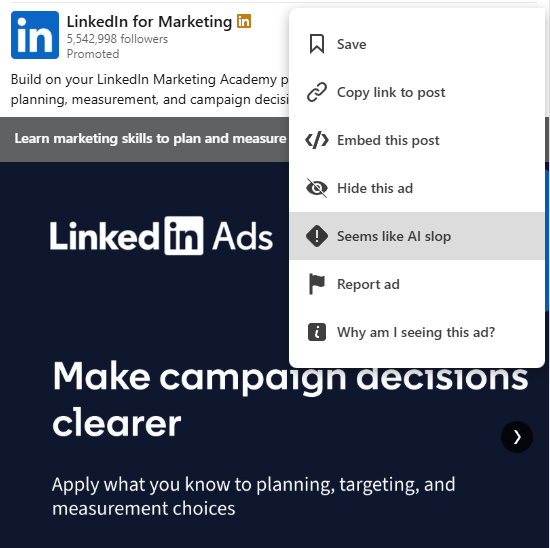
LinkedIn also reported that content classified as AI slop was receiving around 40% fewer views following its detection and reporting changes.
The lesson for brands isn’t:
Stop using AI.
It’s:
Stop using AI to sound like everyone else.
AI can help teams research, organise ideas, analyse information and produce content faster but speed isn’t differentiation.
When hundreds of brands publish the same generic explanations, predictable hooks and recycled opinions, the content becomes increasingly difficult to distinguish.
What stands out?
- A real opinion
- A specific experience
- An original observation
- A useful example
- A perspective backed by evidence
In other words:
Use AI to increase your capability. Don’t use it to remove your point of view.
4. Google Released Its August 2026 Spam Update
Google also rolled out its August 2026 spam update, the third confirmed spam update of 2026. The update applies globally across languages and locations and focuses on improving Google’s systems for identifying search spam.
Google did not announce a specific new spam category alongside the update. But for marketers, it reinforces a bigger shift already happening across search:
Publishing more content doesn’t automatically create more visibility.
With AI making it easier than ever to produce hundreds of pages quickly, brands can be tempted to scale content simply for the sake of covering more keywords.
That’s where the real problem begins.
If pages are repetitive, lightly reworked from existing information or created without adding anything genuinely useful, increasing content volume can create more noise without creating more value.
Instead of asking:
“How many pages can we publish?”
the better question is:
“What does this page add that someone can’t get from the other results?”
That’s where information gain becomes important.
Does the content offer:
- Original insights from genuine expertise or first-hand experience?
- Useful examples or data that add something new?
- A clearer explanation of a problem people are actually trying to solve?
- A perspective that goes beyond simply summarising what already exists?
The goal isn’t to publish the highest volume of pages.
It’s to build pages with enough value, relevance and originality to deserve visibility.
And in an AI-powered search environment, that matters even more. When producing content becomes easier, the value of what you add becomes the differentiator.
5. Google Is Making Marketing Measurement More AI-Driven
AI isn’t only changing how customers search. It is also changing how marketers understand performance.
Google announced updates bringing its AI assistant, Ask Advisor deeper into Google Ads and Google Analytics.
Google Analytics is introducing AI-generated summaries that highlight important changes in performance, while Google Ads is adding AI-powered insight cards and conversational ways to investigate campaign data.
Google is also introducing visual, no-code event tracking allowing advertisers to define events and conversions without manually writing tracking code.
Google is bringing its Google Tag and Google Tag Manager systems closer together as part of this broader measurement update while also making data flows easier to understand.
For smaller marketing teams, this could make conversion tracking and campaign analysis less technically demanding.
But there’s a bigger lesson here.
Marketing teams don’t simply need more data.
They need to understand the right data faster.
The competitive advantage is moving from:
Who has more data?
to:
Who can turn data into a better decision faster?
6. YouTube Changed What a “View” Means
YouTube also changed an important measurement metric this month: a view is now counted when a video or livestream begins playing.
YouTube will continue providing Engaged Views in Analytics so creators can understand how many people actually continued watching.
Why does this matter to marketers?
Because bigger numbers don’t always mean better performance.
A video can collect thousands of views while failing to hold attention.
So brands and creators need to look beyond the headline number.
A view tells you someone started watching.
Engagement tells you they stayed.
As platforms change how metrics are calculated, marketers need to understand what each metric actually represents before using it to evaluate campaigns, creators or content.
7. Google Is Experimenting With AI-Generated Visuals in Search
Google also tested another development that raises an important question for content creators.
AI-generated images appeared inside some Google AI Overviews including examples where generated illustrations were shown alongside recipe-related results.
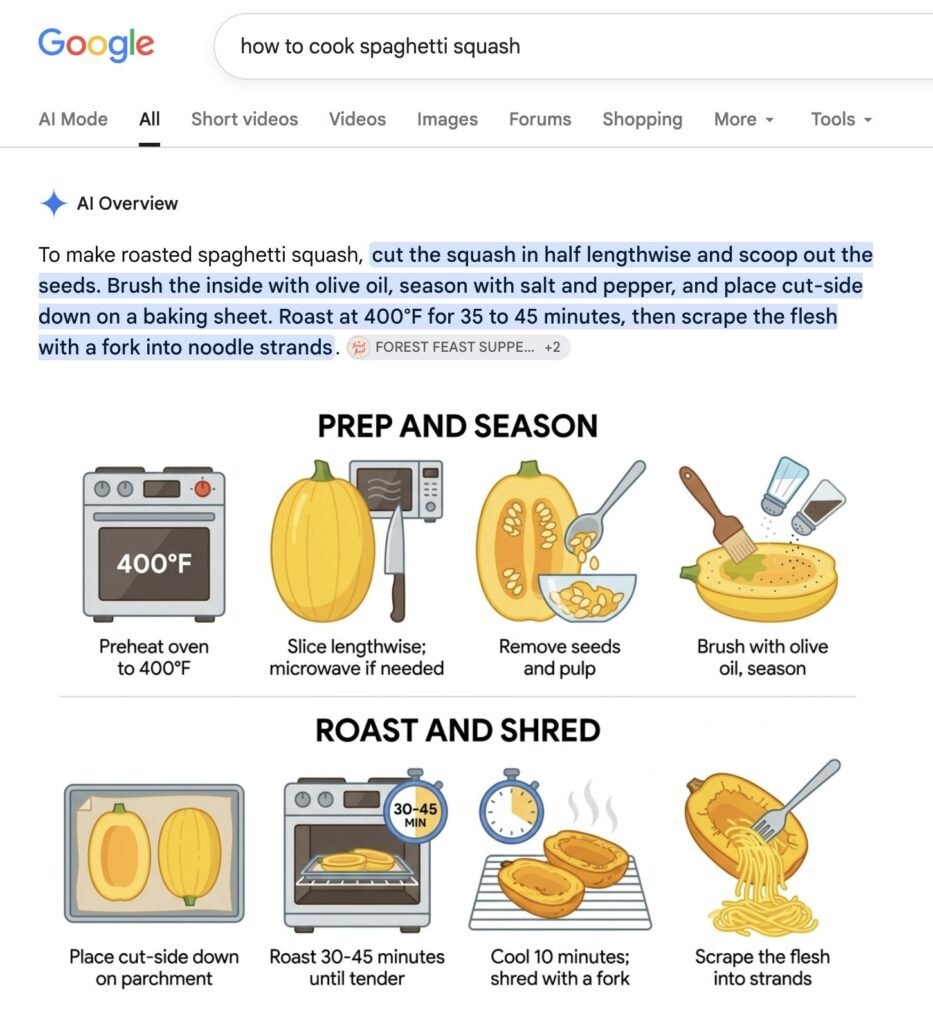
Google later confirmed that the feature was a small experiment and stopped the test.
The experiment may have been temporary but the underlying direction is worth watching.
For years, the relationship was relatively simple:
Create useful content and Google sends users to your website.
AI-powered search changes that dynamic.
Search engines can increasingly summarise information, answer questions and generate parts of the experience without requiring users to visit the original source.
That means simply creating content isn’t enough.
Your content needs to give people a reason to continue to your website.
That reason could be:
- Original research
- A useful tool
- First-hand experience
- Detailed examples
- Proprietary information
- Something an AI-generated summary cannot fully reproduce
The value of the click has to become stronger.
8. Claude Is Adding Invisible Signals to AI-Generated Text
Another development came from Anthropic’s Claude.
According to Anthropic’s announcement, Claude models launched from August 2 onward can embed an invisible watermark into generated text.
Supported files can also carry signed provenance metadata indicating that Claude was involved in generating or processing them.
The move is part of a wider push towards transparency around AI-generated content and provenance.
For marketers and content teams, this creates an important consideration.
AI-generated content is becoming easier to produce.
At the same time, platforms and technology companies are developing more ways to identify where content comes from.
That makes authenticity and human contribution increasingly important.
The future isn’t necessarily:
Human content vs AI content.
It is more likely to be:
Generic AI output vs useful content shaped by real human expertise.
For brands, that distinction matters.
AI can help you create faster.
But the strategy, experience, judgement and original thinking still need to come from somewhere.
9. LinkedIn Is Showing Brands How AI Visibility Is Built
Perhaps one of the most interesting developments for B2B marketers came directly from LinkedIn.
LinkedIn published a framework called The Credibility Stack explaining how brands can strengthen their presence in AI-generated answers.
The framework focuses on building credibility through LinkedIn’s ecosystem including:
- Complete company and professional profiles
- Employee expertise
- Long-form content
- Relevant creators
- Fresh information
- Consistent brand signals
LinkedIn also highlighted that long-form articles can attract more AI citations than shorter feed posts and that content freshness matters.
But there’s a bigger takeaway.
AI visibility isn’t built from a single webpage.
AI systems can encounter information about your brand across an entire digital ecosystem.
Your website matters.
Your LinkedIn presence matters.
Industry publications matter.
Third-party mentions matter.
Your people matter.
And the consistency between these signals matters.
This is where SEO, content strategy, branding and AI search visibility start overlapping.
What These Updates Tell Us About the Future of Marketing
These updates came from different platforms.
But together, they reveal 5 major changes –
1. Search is becoming more conversational
People are increasingly asking complete questions rather than simply entering short keywords.
2. AI is becoming part of the discovery journey
A customer may encounter your brand through an AI-generated answer before visiting your website or social profile.
3. Trust is becoming harder to manufacture
Platforms are actively fighting spam, fake engagement, AI slop and attempts to manipulate discovery systems.
4. Metrics need more context
Views, clicks and rankings still matter but marketers need to understand what those numbers actually represent.
5. Brand visibility is becoming distributed
Your website is important but it is no longer the only place where people or AI systems learn about your brand.
The Bigger Question: How Do We Get Chosen?
For years, marketers and brands asked:
How do we rank higher?
Then:
How do we get more clicks?
Now there’s another question worth asking:
Why should people or AI systems choose our brand over the alternatives?
That requires more than a traditional SEO strategy.
It requires:
- Strong content
- Clear positioning
- Consistent branding
- Real expertise
- Useful information
- Multiple discovery channels
And most importantly:
Something worth choosing.
The internet is becoming increasingly crowded with content. AI can produce more of it in seconds and that makes originality more valuable.
Final Thought
At The Circle, we don’t see these developments as isolated platform updates.
We see them as part of one larger shift in how brands build visibility.
The goal is no longer to simply fill social feeds, publish blogs or chase rankings.
It’s to build a brand that can be:
Discovered. Understood. Trusted. Remembered.
Wherever people are looking.
That means connecting SEO, content, social media, paid campaigns, branding and AI-search visibility into a single broader digital strategy.
Because your next customer might find you through Google or Instagram or LinkedIn or YouTube or Reddit.
Your brand needs to be ready for all of them.